When Meta business products are disrupted, advertisers may temporarily lose access to Ads Manager or find it harder to review delivery and make time-sensitive changes. The operational risk is not the existence of an outage alone; it is having insufficient visibility, ownership and controls when access becomes limited.
If you run paid campaigns on Meta, resilience should be discussed before a disruption rather than after it. If you are unsure whether your current paid advertising setup has appropriate controls, this article explains the practical areas to review.
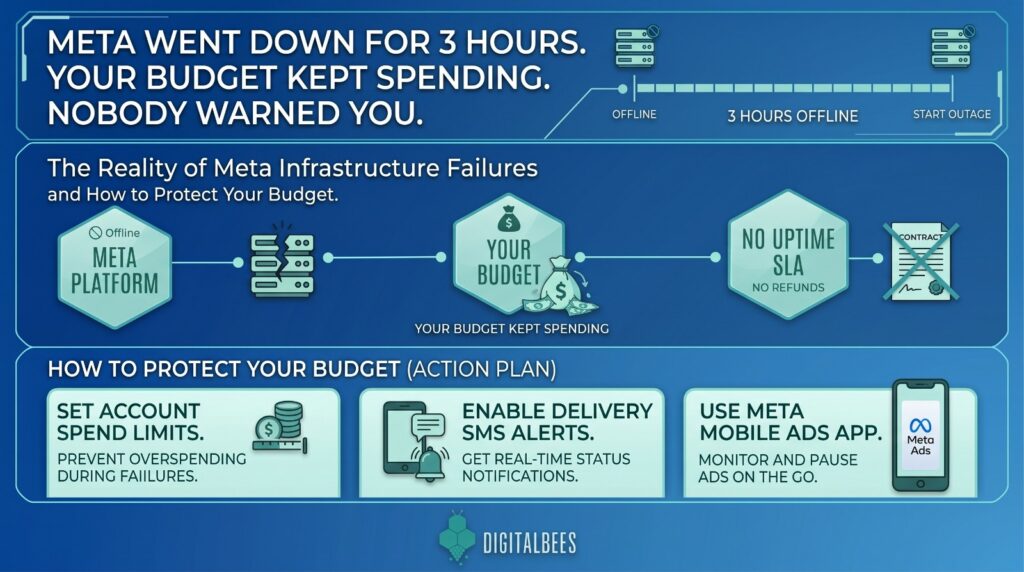
Outages Create a Control and Visibility Risk
Advertisers should not base operational planning on assumed comparisons between platform service-level commitments. Every advertiser needs its own monitoring, escalation and spend-control process rather than relying on an expectation of uninterrupted access or automatic compensation.
Meta maintains an official Ads Manager status page with current status and incident history. During suspected disruption, teams should check that source before relying on unverified outage counts, social-media reports or anecdotal claims.
Prepare for Limited Access, Not a Specific Spend Pattern
A disruption to the Ads Manager interface does not, by itself, establish whether campaigns stopped, continued normally or spent beyond intent. The correct response is to avoid assumptions and verify account delivery, spend, conversions and billing once reliable access is available.
- Check Meta's official status page and record the affected period
- Confirm campaign delivery and account spend when access returns
- Compare platform data with website analytics and conversion records
- Document any verified discrepancy before contacting official support
- Keep decision ownership and escalation contacts clear internally
Your First Line of Defence: Account-Level Spend Limits
Meta describes an ad account spending limit as a cap on the total amount an ad account can spend across its campaigns from the time the limit is set. Meta also states that ads pause when the account spending limit is reached.
That control should complement, not replace, campaign budgets, routine account reviews, delivery alerts and clearly assigned responsibility. Limits must also be set and reviewed in the context of the advertiser's actual billing and operating plan.
Build an Outage Response Checklist
- Name the person responsible for checking platform status and spend
- Keep the official Meta status page accessible to the team
- Define what evidence must be recorded when a disruption is suspected
- Review account and campaign spending controls at an agreed frequency
- Cross-check website analytics, orders and platform reporting after access returns
- Escalate verified discrepancies through official support channels
A structured ad account review should cover ownership, budget settings, tracking, escalation and the steps required to verify what happened. The goal is to make decisions from account evidence rather than assumptions.
Platform Risk Is Part of Your Media Strategy — Treat It That Way
The instinct after an outage is to look for an immediate fix — tighten the budget, set an alert, move on. The more useful response is to ask what the disruption reveals about the structure of the media plan. When one platform accounts for most paid acquisition, limited access to that platform can affect visibility, decision-making and lead flow.
This does not mean abandoning Meta. It means building an operating structure that can respond calmly when access, reporting or delivery information is temporarily disrupted.
A resilient acquisition plan also avoids complete dependence on one paid platform. Marketplace activity, direct demand, customer retention and organic search visibility can form part of a broader channel mix.
The practical safeguards are straightforward: appropriate spending limits, documented monitoring, verified post-incident checks, clear escalation and a more diversified media structure. Their value comes from being established before they are needed.
The cost of ignoring them, however, shows up exactly when you can least afford it.
Digital Bees reviews account structure, tracking and operational controls as part of responsible paid-media planning. Speak with Digital Bees about a structured account review.